Introduction
Anne Bradstreet stands as America’s first significant published poet. She wrote with intellectual depth, spiritual sincerity, and genuine poetic artistry. Her works reflect the Puritan world she inhabited deeply. Yet they also transcend that world with remarkable beauty. Contemplations by Anne Bradstreet represents her greatest single poetic achievement. It is her longest, most ambitious, and most celebrated poem. Furthermore, it explores nature, time, mortality, and God with extraordinary depth. Consequently, the poem holds a central place in early American literature. Additionally, it demonstrates Bradstreet’s remarkable range as a thinker and poet. She moves from the beauty of autumn trees to eternal spiritual questions. Therefore, this poem rewards careful and sustained study at every level. Moreover, it speaks to readers across centuries with living force. Its themes of transience, wonder, and divine grace remain permanently relevant. This complete guide explores every significant dimension of the poem. Readers will gain deep and lasting insight into this masterwork.
1. Anne Bradstreet: Life and Literary Context
Anne Bradstreet arrived in the Massachusetts Bay Colony in 1630. She came from England with her Puritan family. Furthermore, her father, Thomas Dudley, served as colonial governor. Consequently, she grew up surrounded by books and serious learning. She read widely in classical and Renaissance literature. Therefore, her poetry reflects extraordinary intellectual breadth and depth. She married Simon Bradstreet at sixteen years old. Together, they built a demanding life in the New World. Her collection, The Tenth Muse Lately Sprung Up in America, appeared in 1650. It was the first published poetry collection by an American woman. Moreover, it earned admiration on both sides of the Atlantic. Additionally, Bradstreet revised and expanded her poems throughout her life. Consequently, her later work shows a significant deepening of vision. The poem belongs to this mature phase of her writing. Understanding her biography unlocks the poem’s full emotional and spiritual depth.
2. Overview of Contemplations by Anne Bradstreet
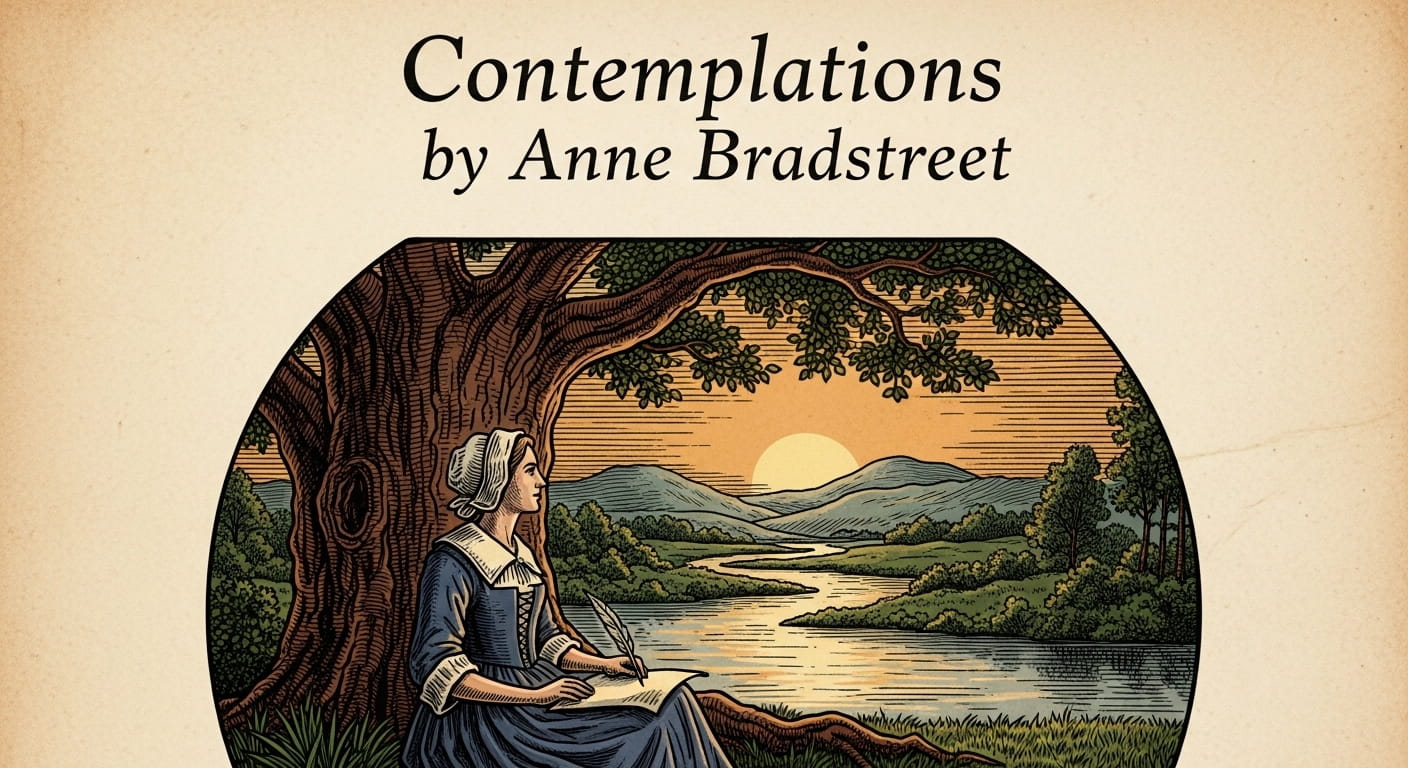
Contemplations by Anne Bradstreet is a long meditative poem of thirty-three stanzas. Each stanza contains seven lines in a demanding rhyme scheme. Furthermore, the poem moves through nature, history, and spiritual reflection. Consequently, it covers an extraordinary range of themes and subjects. Additionally, the poem opens with Bradstreet observing autumn trees outdoors. She moves from natural beauty toward profound theological meditation. Therefore, the poem traces a spiritual and intellectual journey. Moreover, the journey moves from wonder to humility and finally to trust. The poem examines the sun, rivers, grasshoppers, and fish. Furthermore, it meditates on Adam and Eve, Cain, and human mortality. Additionally, it considers the relationship between time and eternity. Consequently, the poem maps the entire created order with loving attention. Each stanza builds on the previous one with careful logic. Therefore, the poem is both intellectually coherent and emotionally moving. The poem rewards patient and attentive reading throughout.
3. The Poem’s Structure and Form
The formal structure of the poem is carefully and deliberately controlled. Each of the thirty-three stanzas contains exactly seven lines. Furthermore, the rhyme scheme follows an intricate and demanding pattern. Consequently, the form gives the meditation aesthetic order and discipline. Additionally, the seven-line stanza was relatively unusual in Bradstreet’s era. Therefore, her choice of this demanding form reflects genuine poetic ambition. Moreover, the stanzaic structure gives each meditation its own contained space. Each stanza develops one aspect of the poem’s larger argument. Furthermore, the poem uses iambic pentameter as its dominant rhythm. This gives the verse a dignified and measured forward movement. Additionally, Bradstreet employs enjambment to create natural flowing momentum. Lines carry their meaning forward without awkward artificial pauses. Consequently, the poem moves with intellectual and emotional fluency. Furthermore, the thirty-three stanzas mirror Christ’s traditional age at crucifixion. Therefore, the number itself carries theological significance. The form of the poem is never merely decorative.
4. The Opening Vision: Autumn Trees and Natural Beauty
The poem opens with Bradstreet standing outdoors in autumn. She observes trees of extraordinary beauty and golden richness. Furthermore, the autumn scene strikes her with sudden overwhelming wonder. Consequently, she begins a meditation on nature’s relationship to God. Additionally, the trees’ golden color suggests both beauty and transience. They are magnificent yet subject to winter’s inevitable approach. Therefore, the opening establishes the poem’s central tension immediately. Moreover, Bradstreet uses the trees to ask a profound question. If creation is so beautiful, how magnificent must the Creator be? Furthermore, the opening stanzas establish nature as a window to God. Creation speaks of divine glory through its own beauty. Additionally, Bradstreet’s response to the trees is genuinely emotional. She does not merely observe but feels wonder and humility. Consequently, the poem begins with an authentic personal experience. The autumn trees invite the poet into deep philosophical meditation. Contemplations by Anne Bradstreet, therefore, begins in sensory beauty and moves toward spiritual truth.
5. The Sun as Symbol of Divine Glory
The sun becomes a powerful and central symbol in the poem. Bradstreet observes the sun with wonder and genuine awe. Furthermore, its light and warmth overwhelm her with admiration. Consequently, she asks whether the sun deserves worship and praise. Additionally, she quickly corrects this impulse with theological precision. The sun is magnificent, but it is only God’s creation. Therefore, true worship belongs only to the Creator alone. Moreover, the sun symbolizes divine glory shining through the natural world. Its light reaches everywhere and gives life to all creation. Furthermore, the sun’s constancy mirrors God’s eternal, unchanging nature. It rises and sets with perfect and reliable regularity. Additionally, Bradstreet contrasts the sun’s constancy with human transience. The sun will outlast every human life and generation. Consequently, the sun meditation deepens the poem’s theme of mortality. The natural world endures while human life rapidly passes away. The sun in the poem is both a beautiful symbol and a theological argument.
6. Nature as Revelation of God
Nature functions throughout the poem as divine revelation. Contemplations by Anne Bradstreet presents the natural world as God’s book. Furthermore, every natural phenomenon points toward its divine Creator. Consequently, observing nature becomes a form of theological inquiry. Additionally, this view reflects the Puritan doctrine of general revelation. God reveals himself through both Scripture and the natural world. Therefore, Bradstreet’s nature meditation is also a religious exercise. Moreover, she reads creation the way a Puritan reads the Bible. Each detail contains meaning that points beyond itself to God. Furthermore, the trees, sun, river, and birds all speak of divine wisdom. They testify to God’s power, beauty, and creative intelligence. Additionally, nature’s beauty increases rather than satisfies Bradstreet’s spiritual longing. She finds that creation points toward something greater than itself. Consequently, nature leads her toward humility before God’s infinite majesty. The natural world is wonderful but ultimately insufficient for the soul. Nature in the poem always points beyond itself toward the divine.
7. The River: Time, Flow, and Eternity
The river becomes a profound and resonant image in the poem. Bradstreet observes a river flowing with steady and relentless momentum. Furthermore, the river’s constant movement suggests the flow of time. Consequently, it becomes a meditation on human mortality and transience. Additionally, the river flows on regardless of human joy or suffering. It does not pause for any individual life or achievement. Therefore, the river represents time’s indifferent and unstoppable passage. Moreover, Bradstreet contrasts the river’s continuity with human brevity. The river has flowed since creation and will flow forever. Furthermore, individual human lives are brief moments beside their banks. They appear, briefly flourish, and then disappear completely. Additionally, the river meditation connects to broader classical and biblical traditions. Rivers as symbols of time appear throughout ancient literature. Consequently, Bradstreet engages a deep and resonant literary tradition. Furthermore, the river also suggests the possibility of spiritual renewal. Its waters flow toward the sea just as souls flow toward God. The river in the poem is one of its most memorable and beautiful images.
8. The Grasshopper and the Fish: Creatures and Contentment
Bradstreet turns her contemplative attention to small creatures. She observes a grasshopper singing in the summer heat. Furthermore, she watches fish swimming freely in clear water. Consequently, she meditates on their apparent contentment and freedom. Additionally, the grasshopper seems perfectly happy in its natural element. It sings without anxiety, ambition, or spiritual burden. Therefore, Bradstreet uses these creatures to reflect on human restlessness. Moreover, she envies the creature’s simple, uncomplicated existence. The fish swims through its world without metaphysical questions. Furthermore, it does not worry about death, sin, or eternity. Additionally, these small creatures live entirely within the present moment. They do not carry the burden of human consciousness. Consequently, the meditation produces a complex and bittersweet reflection. Human beings have consciousness and the capacity for eternal life. Yet this gift comes with burdens that simple creatures never bear. The creatures in Contemplations by Anne Bradstreet illuminate humanity’s unique and complex condition beautifully.
9. Adam and Eve: The Fall and Human Condition
The poem moves from nature into biblical history with purpose. Bradstreet meditates on Adam and Eve in the Garden of Eden. Furthermore, she reflects on their original innocence and subsequent fall. Consequently, the biblical narrative illuminates the human condition deeply. Additionally, Adam and Eve possessed perfect happiness in paradise. They lived in direct communion with God without sin or death. Therefore, their fall represents humanity’s greatest and most catastrophic loss. Moreover, Bradstreet meditates on what was lost through original sin. The perfect relationship with God and nature was broken permanently. Furthermore, mortality, suffering, and spiritual alienation entered human life. Additionally, the Fall explains the transience and sorrow Bradstreet observes in nature. The beautiful world she contemplates is a fallen world. Consequently, its beauty is real but also shadowed by loss. Furthermore, the Adam and Eve meditation connects nature to Scripture directly. The created world reflects both original glory and subsequent fallenness. The Fall in the poem provides the theological framework for the entire poem.
10. Cain and Abel: Violence, Sin, and Human History
Bradstreet extends her biblical meditation to Cain and Abel. She reflects on humanity’s first act of murder with deep sadness. Furthermore, Cain’s killing of Abel represents sin’s destructive power. Consequently, the meditation deepens the poem’s engagement with human fallenness. Additionally, the Cain and Abel story represents the pattern of human history. Violence, jealousy, and destruction recur throughout every age and civilization. Therefore, Bradstreet sees human history as a tragic and repetitive cycle. Moreover, the meditation connects individual sin to collective human failure. One act of violence opened a pattern that never fully closed. Furthermore, Bradstreet uses this meditation to examine divine justice. God sees and judges every act of human wickedness. Additionally, the Cain meditation connects to the poem’s broader temporal theme. Human history is a long story of sin, suffering, and divine patience. Consequently, the poem’s movement through biblical history carries moral weight. It reminds readers of humanity’s deep need for divine grace. The Cain meditation in the poem gives the poem its historical and moral depth.
11. Themes of Transience and Vanity
Transience is one of the poem’s most persistent and powerful themes. Contemplations by Anne Bradstreet returns to it throughout with consistent urgency. Everything in the natural and human world is temporary and passing. Furthermore, beauty fades, seasons change, and human lives end quickly. Consequently, the poem meditates on the brevity of all earthly things. Additionally, this theme connects to the biblical book of Ecclesiastes directly. All earthly pursuits are vanity and pass like morning mist. Therefore, Bradstreet’s meditation carries genuine biblical and theological authority. Moreover, transience extends from individual lives to entire civilizations. Great nations rise and fall like seasons in the natural world. Furthermore, nothing in the sublunary world endures permanently or safely. Additionally, Bradstreet does not present transience with despair or bitterness. Instead, she uses it to redirect attention toward eternal realities. Consequently, transience becomes a spiritual teacher rather than merely a source of sorrow. The passing of earthly things points toward the permanence of God. Transience in the poem always leads toward deeper spiritual wisdom and trust.
12. The Theme of Mortality and Death
Mortality stands at the poem’s philosophical and spiritual center. Bradstreet confronts the reality of death with unflinching courage. Furthermore, she does not soften or avoid its stark and certain reality. Consequently, the poem’s meditation on death carries genuine emotional power. Additionally, mortality connects every section of the poem. Nature’s transience, human history, and biblical narrative all point toward death. Therefore, death is not an isolated theme but the poem’s central concern. Moreover, Bradstreet’s personal experience of illness deepened this meditation. She suffered serious physical illness multiple times throughout her life. Furthermore, she wrote knowing that death was an ever-present reality. Additionally, the poem distinguishes carefully between physical and spiritual death. Physical death ends the body but cannot touch the immortal soul. Consequently, mortality becomes the doorway to eternal life for the faithful. Furthermore, Bradstreet faces death with Puritan confidence and genuine courage. God’s providence governs the moment of every death perfectly. Therefore, mortality in the poem leads not to despair but to hope and trust.
13. Time and Eternity: The Central Tension
The tension between time and eternity drives the entire poem. Contemplations by Anne Bradstreet meditates on this tension throughout. Time governs the natural and human world with absolute authority. Furthermore, nothing within time escapes change, decay, and eventual ending. Consequently, the temporal world is beautiful but ultimately insufficient. Additionally, eternity stands beyond time as its opposite and completion. God exists outside time in perfect and unchanging eternity. Therefore, the contrast between time and eternity frames the poem’s spiritual argument. Moreover, Bradstreet uses natural imagery to explore this contrast vividly. The river flows in time but points toward timeless eternity. Furthermore, the sun rises and sets within time yet mirrors eternal constancy. Additionally, human souls belong to both dimensions simultaneously. They live within time but are destined for eternal life. Consequently, the soul’s longing for eternity produces the poem’s spiritual restlessness. The contemplating mind cannot rest in temporal beauty alone. Time and eternity in the poem create the poem’s central and most productive tension.
14. Puritan Theology and the Poem
Puritan theology shapes every dimension of this poem deeply. Bradstreet was a devout Puritan throughout her entire life. Furthermore, her faith informed everything she observed, thought, and wrote. Consequently, the poem operates within a firmly Puritan theological framework. Additionally, Puritanism emphasized God’s absolute sovereignty over all creation. Every natural phenomenon reflected divine wisdom and providential design. Therefore, Bradstreet’s nature meditation is simultaneously a theological exercise. Moreover, Puritanism taught the doctrine of original sin persistently. Human beings are fallen creatures in a fallen but still beautiful world. Furthermore, the Fall explains the tension between nature’s beauty and its transience. Additionally, Puritan theology emphasized the brevity of earthly life. This world is merely a preparation for eternal life with God. Consequently, the poem’s meditation on transience carries Puritan theological weight. Furthermore, Puritanism valued typological reading of the natural world. Natural phenomena were signs pointing toward spiritual and eternal truths. Therefore, every image in Contemplations by Anne Bradstreet carries theological as well as aesthetic significance.
15. Providence and Divine Sovereignty
Providence is a central theological concept throughout the poem. Bradstreet believed in God’s absolute and perfect providential control. Furthermore, nothing in the natural or human world happened by accident. Consequently, every event reflected God’s wise and purposeful design. Additionally, the poem’s meditation on nature reflects this providential framework. The seasons change according to God’s perfectly ordered plan. Therefore, autumn’s beauty and winter’s coming are both divinely ordained. Moreover, human history unfolds under God’s providential sovereignty. The rise and fall of nations reflects divine judgment and purpose. Furthermore, individual human lives proceed according to God’s perfect will. Additionally, providence gave Bradstreet comfort in the face of mortality. Death was not random or meaningless but part of God’s design. Consequently, trust in providence transformed sorrow into acceptance and peace. Furthermore, the poem’s movement from wonder to humility reflects providential thinking. God’s wisdom surpasses human understanding in every dimension. Providence in the poem gives the poem its spiritual stability and ultimate confidence.
16. The Soul’s Longing for God
The soul’s longing for God pulses throughout the entire poem. Bradstreet experiences nature’s beauty as spiritually insufficient and incomplete. Furthermore, every beautiful thing points beyond itself to something greater. Consequently, the soul cannot find lasting rest in created things alone. Additionally, this longing reflects the Augustinian tradition of Christian spirituality. Augustine famously wrote that the heart is restless until it rests in God. Therefore, Bradstreet’s spiritual restlessness places her in a deep tradition. Moreover, the soul’s longing intensifies as the poem progresses. Each natural meditation reveals the inadequacy of earthly beauty. Furthermore, the soul recognizes its own eternal nature through contemplation. It belongs not to time but to eternity and God. Additionally, the poem’s spiritual longing is expressed with genuine personal emotion. Bradstreet does not merely state theological propositions abstractly. Consequently, the soul’s longing gives the poem genuine emotional warmth and depth. Furthermore, the longing resolves not in despair but in hope and trust. The soul will find its true home in God after death. The soul’s longing in the poem is the poem’s deepest and most moving emotional current.
17. Bradstreet’s Feminist Dimensions
The poem carries significant feminist dimensions. Bradstreet wrote in a world that severely restricted women’s intellectual expression. Furthermore, colonial Puritan society consistently limited women’s public roles. Consequently, her ambitious intellectual poem was itself a courageous act. Additionally, the poem tackles classical, philosophical, and theological subjects directly. These were traditionally masculine domains of knowledge and authority. Therefore, the poem implicitly argues for women’s intellectual equality. Moreover, Bradstreet’s voice in the poem is confident and authoritative. She does not apologize for her learning or her ambitions. Furthermore, she engages the greatest questions of human existence directly. Additionally, her Prologue explicitly addresses critics of female learning. Contemplations by Anne Bradstreet proves the Prologue’s argument through demonstration. Consequently, the poem is Bradstreet’s most powerful feminist statement. It shows rather than argues for women’s intellectual authority. Furthermore, her engagement with nature, history, and theology is fully equal. Therefore, the feminist significance of the poem cannot be overstated.
18. Classical Influences on the Poem
Classical literature shaped the poem’s intellectual and aesthetic dimensions. Bradstreet read widely in classical Greek and Latin literature. Furthermore, she absorbed classical traditions of nature poetry and meditation. Consequently, the poem reflects centuries of accumulated classical wisdom. Additionally, the classical tradition of the locus amoenus — the beautiful natural place — resonates throughout. Bradstreet’s autumn landscape echoes classical pastoral poetry directly. Therefore, the poem participates in a long and distinguished literary tradition. Moreover, classical philosophy informs the poem’s meditation on time and eternity. Platonic ideas about the soul’s immortality echo through the poem. Furthermore, classical Stoic philosophy shapes its treatment of mortality and acceptance. Additionally, Bradstreet’s engagement with classical sources was creative and independent. She adapted classical frameworks to serve her Puritan theological vision. Consequently, the classical and Christian traditions merge in the poem beautifully. Furthermore, this merger reflects Renaissance humanist intellectual practices broadly. Bradstreet read the classics through a firmly Christian interpretive lens. Classical influences in the poem enrich rather than dominate its theological vision.
19. The Poem and The Quaternions
Contemplations by Anne Bradstreet marks a significant development beyond the quaternions. Her earlier Four Elements and Four Humours poems were intellectually ambitious. Furthermore, they demonstrated her mastery of classical cosmological frameworks. Consequently, they established her as a serious philosophical poet. Additionally, the quaternion poems used the formal debate structure throughout. Each element or humour argued its own case and importance. Therefore, they were structured as intellectual exercises rather than personal meditations. Moreover, Contemplations represents a deeper and more personal poetic vision. It abandons the formal debate for genuine personal meditation. Furthermore, it moves from classical frameworks toward direct spiritual experience. Additionally, the poem’s emotional depth surpasses the earlier quaternion poems. Bradstreet’s voice here is more personal, vulnerable, and spiritually urgent. Consequently, Contemplations represents her poetic maturity and greatest achievement. Furthermore, it shows how far her art had developed beyond the quaternions. The progression from quaternions to Contemplations maps her entire poetic journey. The poem stands as the crown of her remarkable literary achievement.
20. Literary Devices and Poetic Craft
Bradstreet employs powerful literary devices throughout this poem skillfully. Contemplations by Anne Bradstreet uses personification with great precision and beauty. Natural phenomena like the sun and the river become vivid presences. Furthermore, the apostrophe allows Bradstreet to address nature directly and intimately. She speaks to the trees and sun with genuine emotional warmth. Consequently, nature feels alive and responsive rather than merely passive. Additionally, the poem uses extended metaphor with sustained intellectual control. The river, as time and the sun, develop throughout as divine glory. Therefore, each metaphor carries philosophical weight across multiple stanzas. Moreover, Bradstreet uses allusions to classical and biblical sources constantly. Each allusion deepens the poem’s intellectual and spiritual resonance. Furthermore, imagery drawn from the natural world is vivid and precise. She observes autumn leaves and river water with careful attention. Additionally, the poem employs anaphora for emphasis and rhythmic power. Repeated grammatical structures create musical patterns within the verse. Consequently, the poem achieves genuine lyric beauty alongside intellectual depth. The literary craft of the poem is among the finest in early American literature.
21. The Poem’s Place in American Literary History
This poem holds a genuinely foundational place in American literary history. It belongs to the very beginning of the American literary tradition. Furthermore, it demonstrates that early American writing achieved genuine sophistication. Colonial writers engaged seriously with the greatest philosophical and theological questions. Consequently, American literature begins with genuine intellectual and spiritual ambition. Additionally, the poem established important precedents for later American literature. It proved that American soil could produce serious, lasting literary art. Moreover, it proved that women could contribute fully to that tradition. Therefore, the poem is more than a literary achievement alone. It is a milestone in American cultural and intellectual history. Furthermore, it connects American literature to its European roots directly. Bradstreet brought Renaissance and classical traditions to colonial American soil. She planted those traditions and adapted them to her new world. Additionally, the poem anticipates later American literary traditions powerfully. Emerson’s nature mysticism echoes Bradstreet’s contemplative approach to creation. Consequently, Contemplations by Anne Bradstreet stands at the beginning of a continuous American tradition. It remains one of the essential poems of the entire American canon.
22. Comparison With Upon the Burning of Our House
Reading this poem alongside Upon the Burning of Our House reveals deep connections. Both poems meditate on the transience of earthly possessions and attachments. Furthermore, both counsel detachment from worldly things in favor of eternal realities. Consequently, the two poems share a core theological and spiritual message. Additionally, both poems draw from Bradstreet’s direct personal experience. The burning house was a real and devastating personal loss. Therefore, both poems transform personal experience into universal spiritual wisdom. Moreover, both demonstrate Bradstreet’s characteristic movement from loss to acceptance. She moves from initial grief toward trust in God’s providence. Furthermore, both poems use vivid concrete imagery to anchor abstract theological ideas. Additionally, the burning house mirrors the transient natural world of Contemplations. Both are beautiful and valuable yet ultimately temporary. Consequently, reading both poems together reveals Bradstreet’s consistent theological vision. Furthermore, together they demonstrate her ability to find spiritual meaning in suffering. Therefore, Contemplations and Upon the Burning of Our House are natural companion poems. Together, they present a complete picture of Bradstreet’s mature spiritual vision.
23. The Poem’s Spiritual Resolution
The poem moves toward a beautiful and confident spiritual resolution. Bradstreet does not end in despair despite confronting mortality and transience. Furthermore, the soul’s longing finds its answer in the promise of eternal life. Consequently, the poem ends with hope, trust, and genuine spiritual confidence. Additionally, the resolution reflects Bradstreet’s deep and tested Puritan faith. She has contemplated the worst realities of human existence honestly. Therefore, her final confidence is earned rather than assumed or inherited. Moreover, the spiritual resolution does not deny the reality of suffering. Bradstreet acknowledges mortality, sin, and transience with full honesty. Furthermore, she simply places these realities within a larger eternal framework. Additionally, God’s providential care extends beyond the limits of earthly life. The soul that trusts in God will find its true home in eternity. Consequently, the poem’s resolution is theologically orthodox yet personally genuine. Furthermore, it reflects a mature faith that has been tested by real experience. The spiritual resolution of the poem gives the poem its ultimate moral and emotional authority.
24. Nature Poetry and the American Tradition
The poem established a powerful tradition of American nature poetry. Bradstreet was the first American writer to meditate on the natural world seriously. Furthermore, she set a precedent that later American poets followed and developed. Consequently, the poem stands at the origin of a major American literary tradition. Additionally, later American writers developed similar relationships with the natural world. Jonathan Edwards described nature as a language of divine symbols. Therefore, Edwards’ nature theology directly echoes Bradstreet’s contemplative approach. Moreover, Ralph Waldo Emerson made nature the center of his philosophical vision. His essays on nature develop themes Bradstreet first explored in this poem. Furthermore, Emily Dickinson observed the natural world with similar spiritual intensity. Additionally, Henry David Thoreau’s Walden shares the poem’s contemplative spirit and method. Consequently, the poem anticipates major currents of American literary thought. Furthermore, it demonstrates that the American engagement with nature has deep colonial roots. Therefore, understanding this poem means understanding where American nature writing began. Bradstreet planted seeds that grew into one of American literature’s greatest traditions.
25. The Poem and Bradstreet’s Personal Faith
The poem reflects Bradstreet’s deeply personal and tested faith. She did not write from a position of easy theological comfort. Furthermore, she suffered illness, loss, and hardship throughout her colonial life. Consequently, her faith was forged in genuine suffering and difficulty. Additionally, the poem’s spiritual questions reflect real personal wrestling with God. Bradstreet genuinely struggled with doubt, grief, and spiritual darkness. Therefore, the poem’s confidence carries the authority of tested conviction. Moreover, her personal journals reveal moments of genuine spiritual struggle. She questioned God’s purposes and wrestled with her own inadequacy. Furthermore, these struggles deepened rather than destroyed her faith ultimately. Additionally, the poem reflects the Puritan practice of spiritual self-examination. Puritans regularly examined their own souls for signs of grace. Consequently, the poem enacts this practice of honest self-scrutiny. Furthermore, Bradstreet’s personal faith gives the poem genuine emotional authenticity. It is not merely a theological exercise but a personal spiritual document. The personal faith in Contemplations by Anne Bradstreet makes it one of the most honest spiritual poems in American literature.
26. Critical Reception and Scholarly Study
Scholars have given the poem increasing and serious critical attention. Early critics often preferred Bradstreet’s shorter, more personal domestic poems. Furthermore, they sometimes overlooked the intellectual ambition of Contemplations. However, modern scholarship has significantly and thoroughly reassessed this view. Consequently, critics now recognize Contemplations as Bradstreet’s greatest achievement. Additionally, feminist criticism has illuminated entirely new dimensions of the poem. Scholars read it as a powerful performance of female intellectual authority. Therefore, the poem’s cultural significance has expanded considerably in recent decades. Moreover, scholars of early American literature place it at the very center. The poem appears in every major American literature anthology regularly. Furthermore, it features prominently in studies of Puritan literary culture. Bradstreet’s engagement with nature and theology fascinates scholars across disciplines. Additionally, ecocritical scholars find the poem’s nature imagery deeply significant. Consequently, the poem attracts genuinely interdisciplinary scholarly attention and engagement. It sits at the crossroads of literature, theology, history, and philosophy productively. Therefore, the poem remains a rich and endlessly rewarding scholarly subject.
27. Teaching and Studying the Poem
This poem rewards careful and sustained study in any educational context. Students gain enormously from close engagement with its language and themes. Furthermore, it introduces colonial American literature in a vivid and personal way. Consequently, students understand the Puritan intellectual world more richly through the poem. Additionally, the poem raises timeless questions about nature, time, and God. These questions provoke genuine personal reflection and intellectual discussion. Therefore, the poem works beautifully as a starting point for philosophical debate. Moreover, the poem’s classical and biblical connections offer rich learning possibilities. Teachers can connect it productively to classical philosophy and Puritan theology. Furthermore, the poem’s nature imagery makes it accessible to all kinds of readers. Additionally, its formal qualities make it excellent for close literary reading. Students learn how form and content work together as an artistic unity. Consequently, it develops both analytical and aesthetic reading skills simultaneously. Furthermore, comparing Bradstreet to Wyatt creates transatlantic perspectives and productive comparisons. For additional literary resources, visit englishlitnotes.com. Explore early American literature at americanlit.englishlitnotes.com.
28. The Poem’s Language and Diction
Bradstreet’s language throughout the poem is precise, controlled, and beautiful. Each word carries genuine weight and deliberate poetic purpose. Furthermore, the diction moves easily between sensory richness and abstract thought. Consequently, the poem achieves intellectual depth without sacrificing aesthetic beauty. Additionally, Bradstreet draws from biblical, classical, and vernacular English sources. Each source enriches the poem’s linguistic texture and resonance. Therefore, the vocabulary is both culturally layered and naturally expressive. Moreover, the poem uses concrete sensory imagery with great precision. She describes autumn leaves, sunlight, and flowing water vividly. Furthermore, this concrete imagery anchors abstract theological ideas in physical reality. Additionally, Bradstreet employs musical sound patterns throughout the poem. Alliteration and assonance create genuine lyric beauty within the verse. Consequently, the poem works as music as well as an argument. Furthermore, the language reflects Bradstreet’s wide reading and deep learning. Yet it never feels academic or cold or artificially elevated. The language of Contemplations by Anne Bradstreet is simultaneously learned and genuinely alive.
29. The Poem’s Relevance to Modern Readers
The poem speaks with striking relevance to modern readers everywhere. Its central questions about nature, time, and meaning remain permanently urgent. Furthermore, modern readers face similar existential questions with similar anxiety. Consequently, Bradstreet’s meditations resonate across four centuries without losing force. Additionally, modern environmental consciousness makes the poem’s nature focus newly relevant. Bradstreet observes the natural world with loving, careful, and reverent attention. Therefore, the poem speaks to contemporary ecological and spiritual concerns powerfully. Moreover, the poem’s meditation on mortality remains urgently relevant to all readers. Every human being must eventually face the questions Bradstreet raises honestly. Furthermore, the poem’s spiritual resolution offers genuine comfort and wisdom. Additionally, modern readers who struggle with faith find the poem’s honesty reassuring. Bradstreet does not pretend that faith is easy or without struggle. Consequently, her honest spiritual wrestling speaks to contemporary doubt with compassion. Furthermore, the poem’s celebration of nature’s beauty invites genuine contemplative practice. Therefore, the poem remains a living and urgently relevant text. Its wisdom speaks as clearly today as in colonial Massachusetts four centuries ago.
30. The Poem and Bradstreet’s Other Works
Contemplations by Anne Bradstreet gains richness from its broader literary context. Reading it alongside her other works reveals consistent philosophical themes. Furthermore, the Four Humours poem demonstrates her earlier classical and systematic approach. Consequently, the contrast with Contemplations reveals her remarkable poetic development. Additionally, the Four Elements poem establishes her engagement with cosmological frameworks. These frameworks inform Contemplations in subtler and deeper ways. Therefore, reading the quaternions illuminates the foundations of the later poem. Moreover, the personal poems about illness and family enrich the contemplative vision. Bradstreet’s domestic experience grounds her abstract meditations in lived reality. Furthermore, her prose meditations in Meditations Divine and Moral share the poem’s spirit. Both reflect her habit of finding theological meaning in everyday experience. Additionally, the poem connects naturally to her treatment of providence across all her works. Consequently, Bradstreet’s entire body of work forms a coherent theological vision. Furthermore, Contemplations stands at the center of that vision. Therefore, it is the essential key to understanding her complete achievement as a poet.
31. The Poem’s Theological Argument
The poem makes a coherent and sustained theological argument throughout. The poem argues that creation always points toward its Creator. Furthermore, natural beauty is real but insufficient for the human soul. Consequently, the soul must look beyond creation toward God himself. Additionally, the Fall explains both nature’s beauty and its transience simultaneously. The world is beautiful because God made it with wisdom and love. Therefore, it is also transient because sin introduced mortality and decay. Moreover, human history reveals both God’s patience and his justice. He allows sin to run its course while maintaining providential control. Furthermore, eternity stands as the answer to all temporal suffering and longing. Additionally, the faithful soul will find its true home in God’s eternal presence. Consequently, the poem’s theological argument moves from creation to redemption. Furthermore, it reflects orthodox Puritan theological convictions throughout every stanza. The argument is not merely academic but personally and spiritually urgent. Therefore, the theological vision of Contemplations by Anne Bradstreet gives the poem its moral and spiritual authority.
32. Legacy and Enduring Significance
The legacy of this poem extends across four centuries of literary history. Contemplations by Anne Bradstreet helped establish American poetry as a serious literary tradition. Furthermore, it proved that colonial America could produce genuine and lasting poetic art. Consequently, later American poets inherited a richer and more ambitious literary tradition. Additionally, the poem’s feminist significance became increasingly recognized in modern times. Bradstreet’s courage in claiming intellectual and spiritual authority remains inspiring. Therefore, the poem continues to speak to readers across gender, culture, and time. Moreover, the poem’s theological depth gives it permanent spiritual relevance. Its meditation on mortality and eternity addresses universal human concerns. Furthermore, its nature poetry anticipates major American literary developments. Additionally, the poem models a form of spiritual contemplation that remains valuable. It teaches readers how to read the natural world with theological attention. Consequently, the poem is not merely historical but genuinely instructive. Furthermore, its formal beauty rewards reading and rereading across a lifetime. Therefore, Contemplations by Anne Bradstreet will continue to inspire readers and scholars. It stands as one of the essential poems of the entire American literary tradition.
Conclusion
Contemplations by Anne Bradstreet stands as her greatest and most enduring achievement. It combines classical learning with personal spiritual urgency and genuine poetic beauty. Furthermore, it speaks universal truths about nature, time, mortality, and God. Consequently, it has resonated with readers across four centuries without losing its force. Additionally, the poem reflects Bradstreet’s extraordinary life and her hard-won spiritual wisdom. She wrote not from theoretical safety but from genuine personal experience and suffering. Therefore, the poem commands genuine intellectual admiration and deep personal respect. Moreover, it demonstrates what lyric poetry can achieve at its philosophical finest. A long meditative poem can carry the full weight of a life’s spiritual journey. Furthermore, it can speak to one specific colonial moment and to all of human history simultaneously. Additionally, Contemplations by Anne Bradstreet invites every reader to examine their own relationship with nature and God. It asks whether we truly see the world’s beauty and what it points toward. Consequently, the poem performs its contemplative function with elegant and lasting power. Furthermore, its formal beauty makes the theological argument genuinely pleasurable to receive. Therefore, it remains one of the essential poems of the English language. Every student and reader gains something genuinely vital from its careful study. Bradstreet’s voice speaks across the centuries with undiminished spiritual authority and enduring human truth.
Discover more from Welcome to My Site of American Literature
Subscribe to get the latest posts sent to your email.